How to Choose Fabrics for Custom Loungewear Sets
Choosing loungewear fabric is a technical decision, not a mood board. A loungewear manufacturer turns your hand-feel and price target into a named spec: knit or woven, GSM, fiber blend, finish and shade. Get that spec right on paper and the sample, fit and cost follow. A low price loungewear manufacturer earns its price from factory-direct structure and full-run fabric buying — never by quietly lowering GSM or swapping the named blend.
- Name the spec: composition, GSM, finish and shade — not just "soft knit".
- Match fabric to use: cotton breathes, modal drapes, recycled blends hold prints and save at volume.
- Use stock cloth when it fits: if your shade card matches, in-stock fabric cuts cost and sampling time without a new dye lot.
Bottom line: a low price loungewear manufacturer lowers cost through structure, not by cutting the material standard — so the fabric you approve is the fabric you receive again on the reorder.
- 01Why Fabric Decides the Whole Set
- 02Knit or Woven: The First Choice
- 03How a Loungewear Manufacturer Reads a Fabric Spec
- 04GSM and Weight: What the Numbers Mean
- 05Fiber Options: Cotton, Modal, Bamboo, Recycled
- 06Stretch, Shrinkage and Colorfastness
- 07Stock Fabric vs Custom Dye
- 08Fabric and Cost: Where Low Price Comes From
- 09A Fabric Checklist Before You Sample
- 10Why Source With MinCharm, a Loungewear Manufacturer
- 11FAQ
Why Fabric Decides the Whole Set
Fabric is the largest single cost line in a loungewear set and the strongest driver of how it feels, drapes and wears. Everything downstream — the fit, the print, the seam, the price — is constrained by the cloth you choose first.
That is why "choose a fabric" is really "write a spec". Breathability, weight, stretch, surface and shade all need to be named before a mill can quote or a factory can sample. A vague instruction produces a vague sample and a cost you cannot trace.
Knit or Woven: The First Choice
Construction comes before fiber. Most loungewear is knit for softness and give; woven sets read more tailored and hold crisp prints. Pick the structure your customer expects:
| Type | Hand & drape | Best for | Trade-off |
|---|---|---|---|
| Single jersey knit | Soft, fluid, light stretch | T-shirts, short sets, summer sleepwear | Can curl at edges; shows wrinkles |
| Rib / interlock knit | Denser, stable, more body | Cuffs, fitted tops, heavier sets | Higher GSM and cost |
| Fleece-backed knit | Warm, brushed, bulky | Cold-season loungewear and hoodies | Heat retention; higher freight by weight |
| Woven (e.g. poplin) | Crisp, structured, little give | Button-front pajama sets, resort sets | Needs accurate sizing; less stretch |
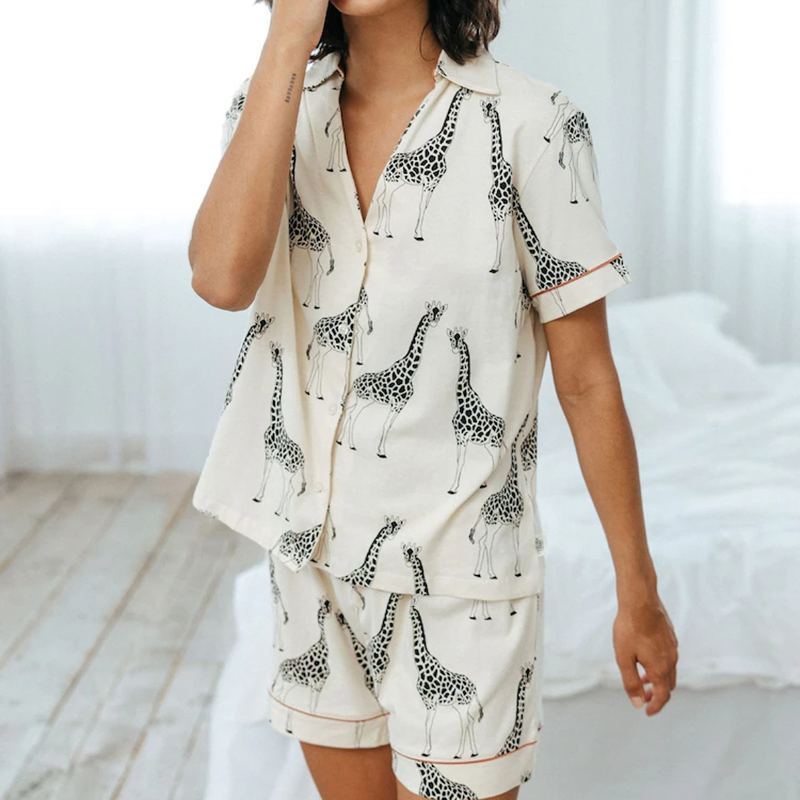
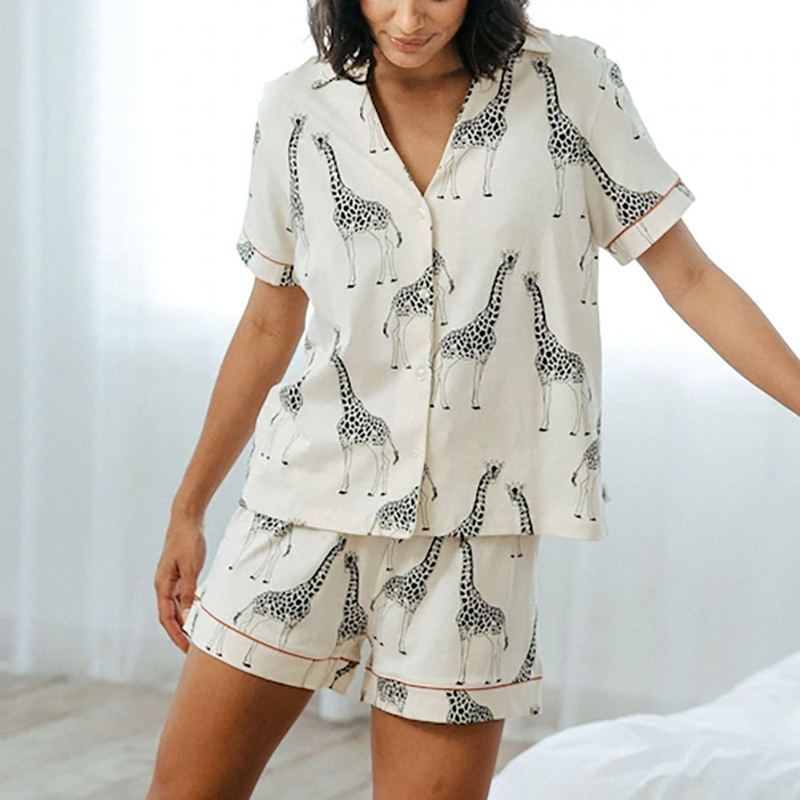
Our published giraffe-print short set (model 2026090901) is a knit set — 95% cotton and 5% spandex, short-sleeve button-front top with contrast piping and elastic-waist shorts. It is a concrete reference for how a knit spec, a print and a trim are written together.
How a Loungewear Manufacturer Reads a Fabric Spec
A loungewear manufacturer with real mill access does not read "soft cotton pajama" as a request — it reads it as a set of questions. Answering them early is what separates a clean quote from a slow one:
- Fiber and ratio: "95% cotton, 5% spandex" is a spec; "cotton feel" is not.
- Weight and finish: GSM, brushed or unbrushed, and whether the surface is printed, solid or textured.
- Color route: an existing shade card or a custom dye lot — with the minimum that each implies.
- Performance: shrinkage and colorfastness acceptance, plus any recycled-content documentation you need to substantiate a claim.
Bring these four answers and a factory can return swatches and a real price. Leave them open and the mill will choose for you — usually the option that is easiest to source, not the one best for your brand.
GSM and Weight: What the Numbers Mean
GSM is grams per square metre. It tells you how heavy the cloth is, which shapes warmth, opacity and drape — but it is not a quality score. A higher number is not automatically better:
- 160–200 GSM: light and breathable, right for summer short sets and warm climates.
- 220–280 GSM: the middle ground for year-round two-piece sets with more body.
- 240–320 GSM brushed or fleece-backed: cold-season loungewear where warmth is the point.
State the target GSM as a range, and confirm it on the approved fabric rather than on a website description. Two suppliers can both call a fabric "heavyweight" and deliver noticeably different cloth.
Fiber Options: Cotton, Modal, Bamboo, Recycled
Once construction and weight are set, fiber decides hand-feel, drape, print behavior and cost. These are the workhorse options for knit loungewear sets:
| Fiber | Feel & performance | Where it wins | Watch for |
|---|---|---|---|
| Cotton | Breathable, soft, easy to print | Everyday sets, broad color range | Shrinkage if not controlled; price moves with cotton market |
| Modal | Silky, fluid drape, soft next to skin | Premium-feel sets and slips | Higher cost per kilo; confirm the blend ratio |
| Bamboo-derived viscose | Smooth, cool, good drape | Warm-weather and premium lines | Verify the actual fiber content behind any "bamboo" claim |
| Recycled polyester blend | Durable, print-friendly, quick-dry | Printed sets, active-leaning lines | Less breathable than cotton; document recycled content |
| Elastane (small share) | Stretch and shape recovery | Fitted tops and waistbands | Usually 3–5%; more does not mean better |
The practical answer is usually a blend. Our giraffe-print set pairs 95% cotton with 5% spandex: cotton for breathability and print, elastane for recovery. A named blend is auditable; a marketing word is not.
Stretch, Shrinkage and Colorfastness
These three properties decide whether the sample you approve survives the wash and the reorder. Put acceptance criteria in writing before bulk:
- Stretch and recovery: ask for the elastane percentage and test whether the rib and waistband return to shape after wear.
- Shrinkage: wash and dry a fabric panel, then measure length and width change against the original.
- Colorfastness: rub a white cloth against the print and the solid shade to check transfer; check the darkest color first.
- Consistency: confirm the bulk lot matches the approved shade, because a dye-lot shift can change a set's look without changing its spec sheet.
Sampling is where these checks belong. A first sample takes 7–10 days at MinCharm, which is enough time to test the cloth rather than just admire the print.
Stock Fabric vs Custom Dye
This is the single biggest lever on both cost and lead time, and it deserves an explicit decision. Supplier in-stock fabric arrives already woven, dyed and inspected; a custom dye lot begins with your own shade:
- In-stock fabric: no new dye lot, faster sampling and a lower price. The limit is the shade card and the quantity on the roll — you choose from what exists.
- Custom dye: an owned signature color that competitors cannot match, at the cost of a dye-lot minimum and extra lead time.
If your brand does not need an exclusive shade, in-stock cloth is the fastest legitimate route to a lower loungewear cost without lowering the standard — the material is already finished and inspected. Confirm the shade card and available quantity in writing; a color that runs out mid-run is not a saving. This is the same condition we flag in development: stock cloth needs no dyeing, so the saving comes from the route, not from the material quality.
Fabric and Cost: Where Low Price Comes From
Fabric dominates the cost sheet, so a lower quote has to come from a visible source. At an own factory, the sources are structural:
- Full-run buying: cloth purchased at production volume rather than sample quantity.
- Stock route: using an existing shade card when an exclusive color is not required.
- Shared fabric: two to four styles built on one base cloth share mill setup and reduce waste.
- No trading layer: mill and process margins return to the buyer instead of a resale markup.
That is a factory-direct low price you can audit line by line — the indicative FOB from US$2 reflects this structure. It is different from lowering GSM, swapping an elastane blend for a cheaper fiber or skipping inspection. Those lower the number on the quote and move the cost onto your PO in the form of returns, reworks and lost customers.
A Fabric Checklist Before You Sample
Run this list before you approve a fabric. Eight items turn a preference into a spec a mill can quote:
Worked in this order, the fabric choice stops being a guess. Each item has a checkable answer — and a factory can price the set you actually want to make.
Why Source With MinCharm, a Loungewear Manufacturer
Fabric decisions hold best with a factory that can source, sample and inspect under one standard. MinCharm's claims are verifiable before the PO:
- Real own capacity: 11,000 ㎡ factory, 200+ workers, up to 600,000 pcs/month — scale that supports full-run fabric buying and repeat runs under one roof.
- Low price loungewear manufacturer: as an own-factory manufacturer, not a trading middleman, MinCharm returns mill and process margins to you — the indicative FOB from US$2 reflects factory-direct pricing, not a resale markup. Low price comes from structure, never from cutting the material standard.
- Fabric library: swatches and supplier stock that shorten sampling, with the shade card and quantity confirmed in writing.
- Sample-locked: a sealed golden sample and AQL 2.5 plus full inspection hold the fabric standard from the first run to the reorder.
- Traceable compliance: OEKO-TEX / BSCI / GRS / ISO 9001 via selected partner factories per project; see the OEKO-TEX STANDARD 100 scope.
- Predictable terms: FOB Shenzhen, 50% deposit / balance before shipment, standard 1,000 pcs per style/color MOQ, 25–35 day bulk.
To see how a real style is specified before you choose fabric, start from our Custom Loungewear Manufacturer service page.
About MinCharm's Loungewear Fabric Sourcing
MinCharm has developed and manufactured apparel in Dongguan (Guangdong) since 2014, with its own factory plus a Specialized Manufacturing Network for collaborative capacity. On loungewear we start from your fabric brief — composition, GSM, shade and finish — and hold that spec through swatches, sampling, bulk and reorder.
As a factory-direct loungewear manufacturer with our own Dongguan plant, MinCharm offers low-price custom loungewear built on scale (up to 600,000 pcs/month) and bulk fabric sourcing. Low price stays paired with the material standard, never traded away from it.
For buyers comparing fabric routes, our Loungewear Sourcing Guide notes: the standard per-style/color minimum holds the acceptance standard — volume changes production rhythm and cost, not the standard we measure against. Content compiled by the MinCharm content team for brand and sourcing decision reference.
What fabric is best for loungewear sets?
There is no single best fabric — it depends on the hand-feel, weight and climate you are targeting. Cotton jersey is breathable and familiar; modal and bamboo blends feel softer and drape better; recycled polyester blends hold prints well and cost less at volume. A custom loungewear manufacturer will map each option to your target FOB.
What GSM should loungewear be?
For a light two-piece set, 160–200 GSM is a common band; heavier brushed or fleece-backed loungewear sits around 240–320 GSM. GSM is not a quality score — it is a weight target that must match the season and the drape you want. Ask for the actual fabric spec, not just the word 'premium'.
Is cotton or modal better for loungewear?
Cotton is breathable, easy to print and widely available; modal and bamboo-derived viscose feel silkier and drape more fluidly but cost more per kilo. Many loungewear fabric blends combine them — for example cotton with a small elastane share for recovery. The right choice is the one that fits your price band and care instructions.
What does 95% cotton and 5% spandex mean?
It means the fabric is 95% cotton and 5% elastane (spandex). The cotton gives breathability and a soft hand; the small elastane share adds stretch and recovery so the set keeps its shape. Our published giraffe-print short set (model 2026090901) uses exactly this blend at FOB USD 7–12 per set.
How do I check shrinkage and colorfastness?
Ask the mill for test results on the exact fabric lot, then confirm both on the first sample: wash and dry a panel to measure dimensional change, and rub a white cloth against the print to check transfer. A manufacturer should state the acceptance criteria before bulk, not after a complaint.
When does in-stock fabric make sense?
When your shade card fits the supplier's existing colors and your volume fits the available roll. In-stock cloth needs no new dye lot, so it reaches a lower price faster and shortens sampling — a legitimate route to a low price loungewear program. Confirm the shade card and quantity in writing, because a color that runs out mid-run is not a saving.
Can a low price still mean good fabric?
Yes, when the low price is structural. An own factory buys cloth at full-run volume and returns mill and process margins instead of adding a trading markup — that is a factory-direct price you can audit line by line. It is not the same as lowering GSM, swapping a named blend or skipping inspection.
What should I specify in my fabric tech pack?
Fiber composition, GSM, finish, approved shade and shade-card reference, width, shrinkage and colorfastness acceptance, print or embroidery artwork with placement, and the golden sample ID. The more precise the fabric line, the fewer surprises between sample and bulk.
Send MinCharm your fabric brief — composition, GSM, shade card, target FOB and launch window — and our team will return swatches, an honest cost breakdown and a sample built to your spec. A factory-direct low-price loungewear program where low price comes from structure, never from a lowered material standard.
Request a QuoteContact: Tel +86 13712870144 | WhatsApp 8613712870144 | Address: No.2 Road of Industrial Zone 12, Dongguan City, Guangdong Province, China